The barcode as we know it—the familiar series of vertical black lines that has graced nearly every consumer product since 1974—is about to change forever. GS1 Sunrise 2027 is the global initiative set to replace traditional 1D barcodes with data-rich 2D codes, such as QR codes and GS1 DataMatrix.
This transition isn’t just a cosmetic update; it’s a digital revolution for the retail industry. By the end of 2027, the goal is for all retail point-of-sale (POS) systems worldwide to be capable of scanning and processing these next-generation codes.
What is GS1 Sunrise 2027?
GS1 Sunrise 2027 is an industry-wide milestone established by GS1, the global standards organization. The initiative mandates that by December 31, 2027, retailers must have the hardware and software infrastructure in place to read 2D barcodes at checkout.
For 50 years, the 1D UPC/EAN barcode has served one primary purpose: identifying a product’s Global Trade Item Number (GTIN) for price look-up. However, modern supply chains and consumers demand more. 2D barcodes can hold significantly more data—up to 7,000 characters—allowing brands to embed expiration dates, batch numbers, serial numbers, and even URLs into a single, compact symbol.
Key Components of the Transition
- 1D Barcodes: Traditional linear barcodes (UPC/EAN) that only store a GTIN.
- 2D Barcodes: Advanced codes like QR Codes (powered by GS1 Digital Link) and GS1 DataMatrix that store multi-dimensional data.
- GS1 Digital Link: A standard that allows a 2D code to function like a web link, connecting the physical product to a “digital twin” on the internet.
Why the Shift? The Limitations of 1D Barcodes
The “beep” heard at the checkout counter has remained largely unchanged since the 1970s. But as the world becomes more data-driven, the 1D barcode has reached its limit.
- Limited Data Capacity: 1D barcodes only identify what a product is. They cannot distinguish between two identical boxes of milk with different expiration dates.
- Packaging Clutter: To provide extra information (like a QR code for a website or a separate barcode for internal tracking), manufacturers often “double” or “triple” barcode their packaging, wasting valuable design space.
- Lack of Traceability: In the event of a product recall, 1D barcodes can only identify the product type, often forcing retailers to pull all stock. 2D barcodes allow for “surgical” recalls by identifying the specific batch or lot affected.
The Benefits of 2D Barcodes
The transition to GS1 Sunrise 2027 offers transformative advantages across the entire value chain.
1. For Retailers: Operational Excellence
- Automatic Expiry Management: Scanners can alert cashiers if a product is past its “sell-by” date, preventing the sale of expired goods.
- Dynamic Discounting: Retailers can automatically apply discounts to items nearing their expiration date directly at the POS.
- Inventory Accuracy: Real-time visibility into stock levels, batch locations, and serial numbers.
2. For Manufacturers: Brand Protection & Transparency
- Enhanced Traceability: 2D codes support “farm-to-fork” transparency, allowing manufacturers to track every step of the journey.
- Anti-Counterfeiting: Unique serialization makes it much harder for counterfeit goods to enter the supply chain.
- Sustainability: Brands can provide digital recycling instructions or sourcing details without cluttering the physical label.
3. For Consumers: The “Smart” Shopping Experience
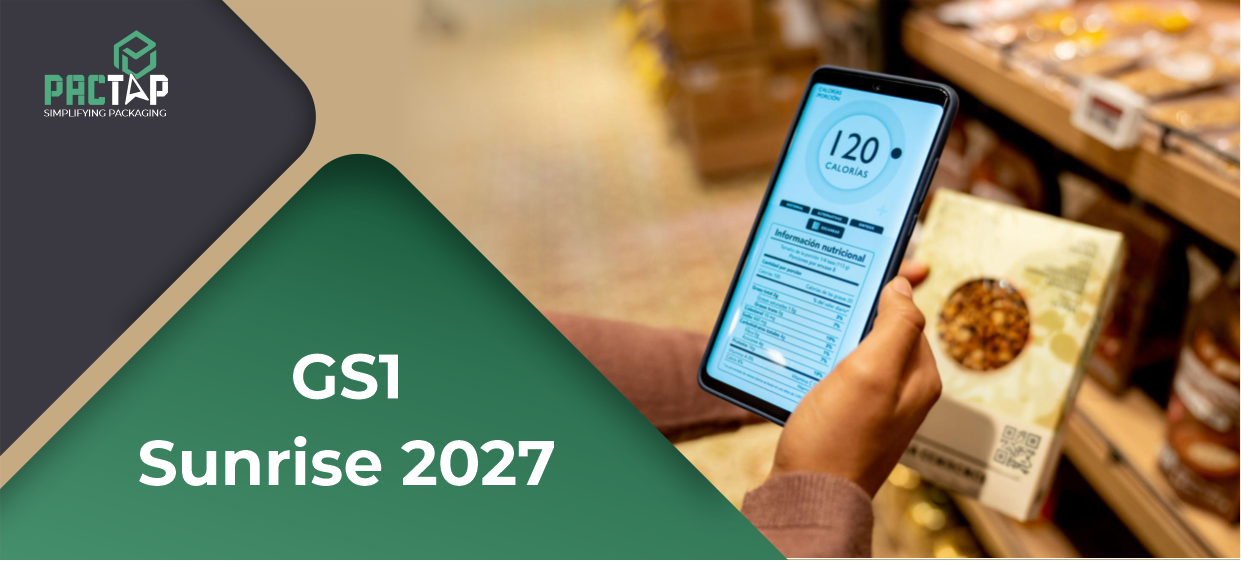
Consumers can scan the same code used by the cashier with their smartphone to access:
- Detailed ingredient and allergen lists.
- Promotional offers and loyalty rewards.
- Authenticity verification.
- Video tutorials or “how-to” guides.
How to Prepare for GS1 Sunrise 2027?
The countdown to 2027 is on. Businesses that wait until the last minute risk supply chain disruptions and loss of retail partnerships.
Step 1: Audit Your Hardware
The most significant hurdle for retailers is the scanner. Traditional laser scanners cannot read 2D codes. Retailers must upgrade to image-based scanners (camera-based) that can capture data from both 1D and 2D formats.
Step 2: Update Your Software
It is not enough to just “read” the code; your POS and ERP systems must be able to parse the data. This means your software needs to recognize the GTIN, expiry date, and batch number within the GS1 Digital Link string.
Step 3: Redesign Packaging (The “Dual-Barcoding” Phase)
Until 2027, GS1 recommends a dual-barcode approach. Since not every retailer will be ready simultaneously, manufacturers should print both the traditional 1D barcode and the new 2D code on their packaging to ensure 100% scan rates during the transition.
Step 4: Choose the Right Printing Technology
2D barcodes require higher print resolution than 1D codes. Manufacturers may need to upgrade to high-speed digital printers or thermal transfer systems to ensure every dot in a DataMatrix or QR code is crisp and scannable.
Technical Comparison: 1D vs. 2D Barcodes
| Feature | 1D Barcode (UPC/EAN) | 2D Barcode (QR/DataMatrix) |
|---|---|---|
| Data Capacity | Low (approx. 20-25 characters) | High (up to 7,000 characters) |
| Data Type | Numeric only | Alphanumeric, Binary, URLs |
| Scan Orientation | Must be scanned horizontally | Scannable from any angle (360°) |
| Damaged Code Recovery | None | Built-in error correction (can scan if partially torn) |
| Consumer Interaction | Requires separate QR code | One code for POS and Consumer |
Conclusion
GS1 Sunrise 2027 represents the most significant change to global trade since the invention of the barcode itself. While the transition requires investment in hardware and software, the ROI is found in a more resilient, transparent, and efficient supply chain.
By embracing 2D barcodes and the GS1 Digital Link standard, brands are not just complying with a new mandate—they are opening a direct digital channel to their consumers and future-proofing their operations for the next 50 years.