In the modern manufacturing landscape, the “where” of your supply chain is just as critical as the “what.” For companies dealing with physical products, packaging is often the final frontier of cost optimization and brand identity. However, as global markets face increasing volatility, a central debate has emerged: Nearshoring vs. Offshoring.
This guide provides a comprehensive deep dive into both strategies specifically for the packaging industry, helping you determine which model fits your business goals in 2026.
Understanding the Fundamentals
Before diving into the comparison, let’s define the players.
What is Offshoring?
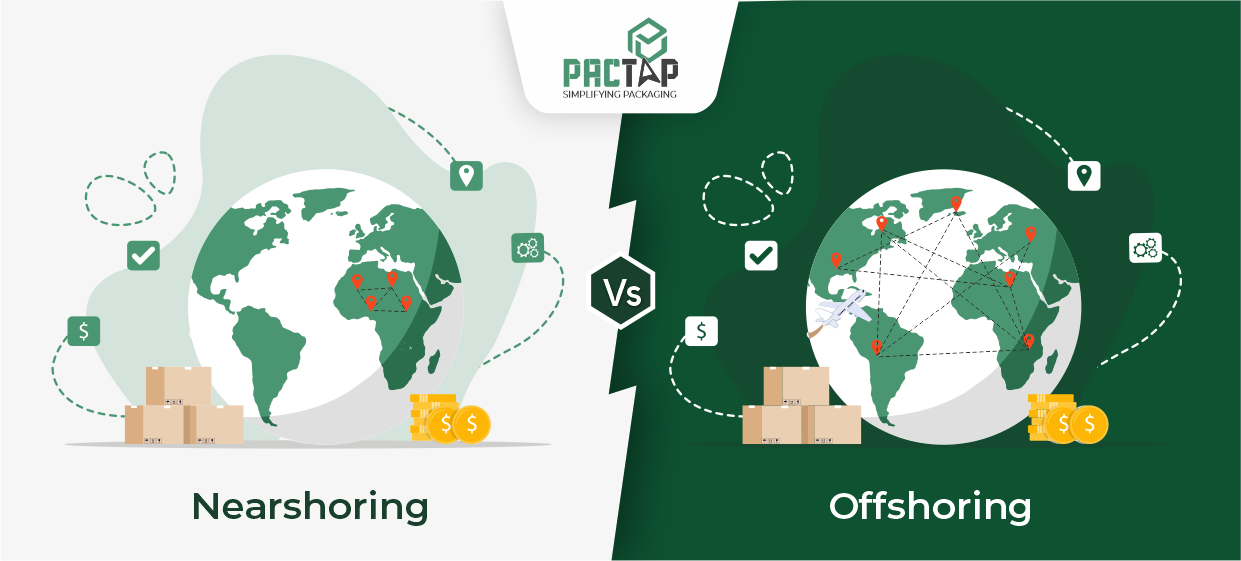
Offshoring involves relocating packaging production to a distant country—historically in Southeast Asia (China, Vietnam) or Eastern Europe—to take advantage of significantly lower labor costs and massive industrial scale.
What is Nearshoring?
Nearshoring is the practice of outsourcing packaging production to a neighboring country or to a country within the same geographic region (e.g., a U.S. company sourcing from Mexico or a German company sourcing from Poland). It aims to balance cost-efficiency with proximity.
The Core Comparison: Nearshoring vs. Offshoring
| Feature | Offshoring (Distant) | Nearshoring (Regional) |
|---|---|---|
| Labor Costs | Lowest | Moderate to Low |
| Shipping Time | 4–8 weeks | 2–7 days |
| Supply Chain Control | Complex / Low | High / Transparent |
| Carbon Footprint | High (Ocean/Air freight) | Lower (Land transport) |
| Minimum Order (MOQ) | High | Flexible |
| Time-to-Market | Slow | Rapid |
The Case for Offshoring Packaging
For decades, offshoring was the default choice for high-volume consumer goods. Here is why it remains a powerhouse:
Economies of Scale
Offshore hubs like China have built “packaging cities” where raw material suppliers, printers, and finishing plants are all within a few miles of each other. This density allows for unbeatable unit prices on massive runs (e.g., 500,000+ units).
Advanced Technical Capabilities
Because these regions have focused on manufacturing for decades, they often possess the most advanced machinery for specialized packaging, such as intricate rigid boxes for electronics or high-end sustainable polymers that require specific molding tech.
Specialized Labor
In regions with a high concentration of manufacturing, there is a deep pool of labor skilled in manual assembly—essential for luxury “kitting” or hand-folded specialty boxes.
The Case for Nearshoring Packaging
Recent disruptions (pandemics, canal blockages, and geopolitical shifts) have made nearshoring the “gold standard” for resilience.
Agility and Lead Times
In a world of “fast fashion” and viral trends, waiting two months for a container to arrive from overseas is a liability. Nearshoring allows brands to pivot their packaging design or replenish stock in a matter of days.
Reduced Logistics Costs
While offshore labor is cheaper, shipping is not. Ocean freight rates are volatile. Nearshoring utilizes trucking and rail, which offer more predictable pricing and eliminate many of the port congestion fees and customs delays associated with international waters.
Cultural and Time Zone Alignment
Communication is the silent killer of quality. Working with a partner in a similar time zone means real-time problem-solving. It’s much easier to fly a quality control team to a neighboring country for a day than to send them across the globe for a week.
Sustainability and ESG Goals
Consumers are increasingly scrutinizing the “miles” a product travels. Nearshoring drastically reduces the carbon emissions associated with long-haul shipping, helping brands meet their Net Zero targets.
Cost Analysis: Beyond the Unit Price
One of the biggest mistakes procurement officers make is focusing solely on the Price Per Unit (PPU). To choose correctly, you must look at the Total Cost of Ownership (TCO).
Hidden Costs of Offshoring:
- Inventory Carrying Costs: Because lead times are long, you must hold more “safety stock” in your warehouse, tying up capital.
- Quality Risk: If a batch of 100,000 boxes arrives with a typo after 6 weeks at sea, the cost of the mistake is astronomical.
- Customs and Tariffs: Trade wars and changing import duties can suddenly add 10–25% to your costs.
Value Adds of Nearshoring:
- Lower MOQs: Nearshore providers are often more willing to accept smaller orders, which is vital for startups or limited-edition product launches.
- Cash Flow: You pay for what you need now, rather than paying for six months of inventory upfront.
Sustainability: The New Deciding Factor
Packaging is under the microscope for its environmental impact. Here is how the two models stack up:
- Material Sourcing: Offshoring often relies on local raw materials that may not meet the same environmental certifications (like FSC) as regional sources.
- Transportation: Shipping a heavy pallet of glass or cardboard 8,000 miles is inherently carbon-intensive.
- Waste: Long-distance shipping requires more “tertiary packaging” (extra plastic wrap, corner protectors, and heavy-duty shipping crates) just to ensure the primary packaging isn’t damaged in transit.
Which One Should You Choose?
Choose Offshoring if:
- You have a static design that won’t change for 12–24 months.
- Your volumes are exceptionally high (millions of units).
- Your product is lightweight (minimizing shipping costs).
- Unit price is the only factor in your survival.
Choose Nearshoring if:
- You operate in e-commerce or retail with seasonal peaks.
- Your brand prioritizes sustainability and eco-friendly messaging.
- You want to reduce “dead stock” and optimize cash flow.
- You require high levels of customization and frequent design updates.
Conclusion
The “Nearshoring vs. Offshoring” debate isn’t about finding a winner; it’s about finding the right balance. Many of the world’s most successful brands are moving toward a “Regional for Regional” strategy—producing packaging near the market where the product will actually be sold.
While offshoring offers the allure of the lowest possible production price, the agility, security, and sustainability of nearshoring are becoming impossible to ignore in an unpredictable global economy. Assess your TCO, look at your carbon goals, and choose the path that protects your supply chain as much as it protects your margins.